Pareto Charts Provide Focus
(Here is our video link that describes Pareto Introduction).
Pareto charts show us where to focus our problem solving efforts, and are very useful for improving metrics like waste, downtime, warranty, etc. The power of Pareto charts lies in the Pareto Principle, which can be stated as: typically a small number of factors will influence a given outcome the most.
Pareto charts provide crystal-clear focus. For example, a student’s chances of getting into college will be mostly determined by two things: high school grades and standardized testing scores. Books have been written about the many factors affecting college acceptance decisions, but the reality is that excellent grades and competitive testing scores make up the majority of the equation for most schools. Students who excel in these to areas will have their choice of colleges to attend.
A Practical Example
Imagine working on a project to reduce your energy bills at home. There are three possible approaches you might take:
(1) minimize the use of all the appliances in your home simultaneously,
(2) minimize the use of appliances that you think use the most energy, or
(3) build a Pareto chart showing the energy consumed each type of appliance, and focus on the high-energy appliances.
The first approach will result in a great deal of sacrifice but will only produce marginal results, because focusing on all appliances equally takes focus away from the vital-few appliances that use the most energy.
The second approach is a roll of the dice, and won’t deliver a high success rate, on average.
The Pareto chart that could be used for approach (3) is below (source data from Clark Public Utilities):
The Pareto chart above brings immediate focus to the project: 5 out of 22 appliances consume 75% of home energy costs. Focus on those appliances and forget about the rest. A resulting action list might be –
- Buy a more efficient water heater.
- Negotiate the heating oil contract in the summer months to obtain a better price.
- Get rid of the water bed – who would have guessed that a heated water bed used so much energy?
- Switch from incandescent to fluorescent light bulbs.
- Enjoy the TV, microwave oven, computer, etc. – they use an insignificant amount of energy compared to the top 5 appliances in the house.
The Pareto Principle is at work everywhere, and the real goal of any Six Sigma project is to find the top two or three factors that make up the true Pareto chart for a given problem, and then control those factors to achieve breakthrough performance. It’s that simple.
A Typical Pareto Chart
Here is a simple Pareto chart showing reasons for arriving late to work over the past year (Excel® file) –
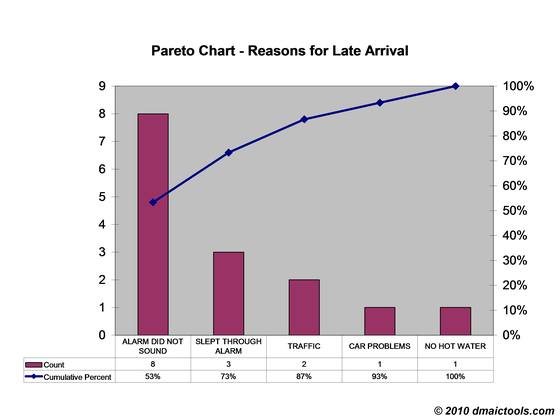
This is a standard format for Pareto charts – the count is noted on the left y-axis: this person was late eight times due to his alarm clock not sounding. The blue line and right-hand axis show the cumulative percentage for all reasons noted on the Pareto chart: in the case, the top two causes (alarm clock not sounding and sleeping through the alarm) account for 73% of the reasons for being late over the last year.
How to Make a Pareto Chart
1. Clearly define the scope
Define the scope clearly – examples include Reasons for shipment delays, Reasons for scrap in plant XYZ, reasons for wrong medication administered, etc.
2. Find out if data already exists
There are many cases where Pareto data already exists, but has never been analyzed. For example, a manufacturing plant may not have the details behind why materials are being scrapped, but most plants will know what is being scrapped, since this information is necessary for inventory control. Building the high-level Pareto on what materials are being scrapped will help focus the data collection effort for building sub-Paretos on the Whys.
3. If data does not exist, come up with a plan to collect the data
When data does not already exist, a carefully planned data collection effort will be needed. Pareto categories (that will go along the bottom axis) should be anticipated ahead of time if possible.
4. Summarize and sort the data in descending order
Here is a data set, ready to be plotted -
5. Create the chart
Use this Excel® file if you need a starting point.
Diving Deep with Sub-Pareto Charts
It’s very common to produce sub-Pareto charts as well. For example, in the above case it might be useful to build a Pareto chart that focuses on the reasons behind the first bar on the top-level Pareto (why the alarm clock didn’t sound). The sub-Pareto chart might look like this –
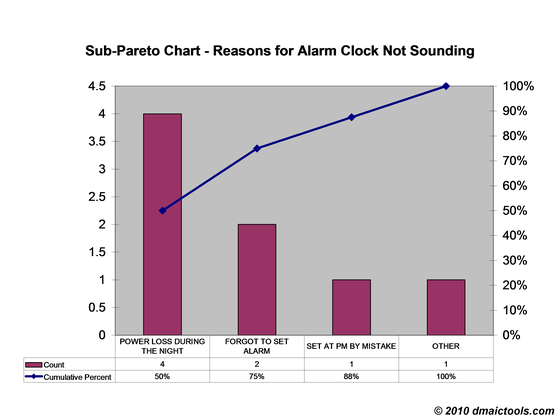
Now we are finally getting down to some actionable items, like buying an alarm clock with a backup battery in case of a power loss.
Two Situations Where Pareto Charts are Not Helpful
Pareto charts are very useful when top-level reasons for a problem are fairly straightforward and can be categorized. This is commonly the case with business metrics. But there are situations where Pareto charts are not helpful or are simply irrelevant to the problem at-hand:
1. Improving process capability a specific CTQ
Many Six Sigma projects are focused at the CTQ level, and Pareto charts are not very helpful in these situations. For example, a Black Belt focused on achieving six sigma capability on a machined casting dimension will have little use for a Pareto chart.
2. “Flat” Pareto charts
There are cases where the Pareto Principle simply does not apply. This is especially true when the major causes surrounding a particular problem are already addressed, and only the long “tail” of the original Pareto remains. Usually at this point in time the underlying metric is performing very well, and the management team should re-evaluate the project’s worth before proceeding (i.e. return to the Define phase and make sure the team is focused on the best possible project).
Wrap Up
There are many situations where a process has been neglected over time (i.e. not supported), and the team running the process on a daily basis truly knows the reasons behind the poor performance. We’ve seen this with scrap reduction projects – basic tooling refurbishments and preventive maintenance have reduced scrap rates by more than 80%. The Pareto chart is an excellent tool for documenting the current state and setting priorities in cases like this.


